My Work from the Regional Stage of the All-Russian Literature Olympiad for Schoolchildren, 2019

Мы загрузимся через одно мгновение!
In my life, in fact, I have written a successful regional round only once.
The very first one. I was fifteen then, I had an enormous love for the artistic world, a stylistic hop-skip, and a gigantic desire to show how I love this text.
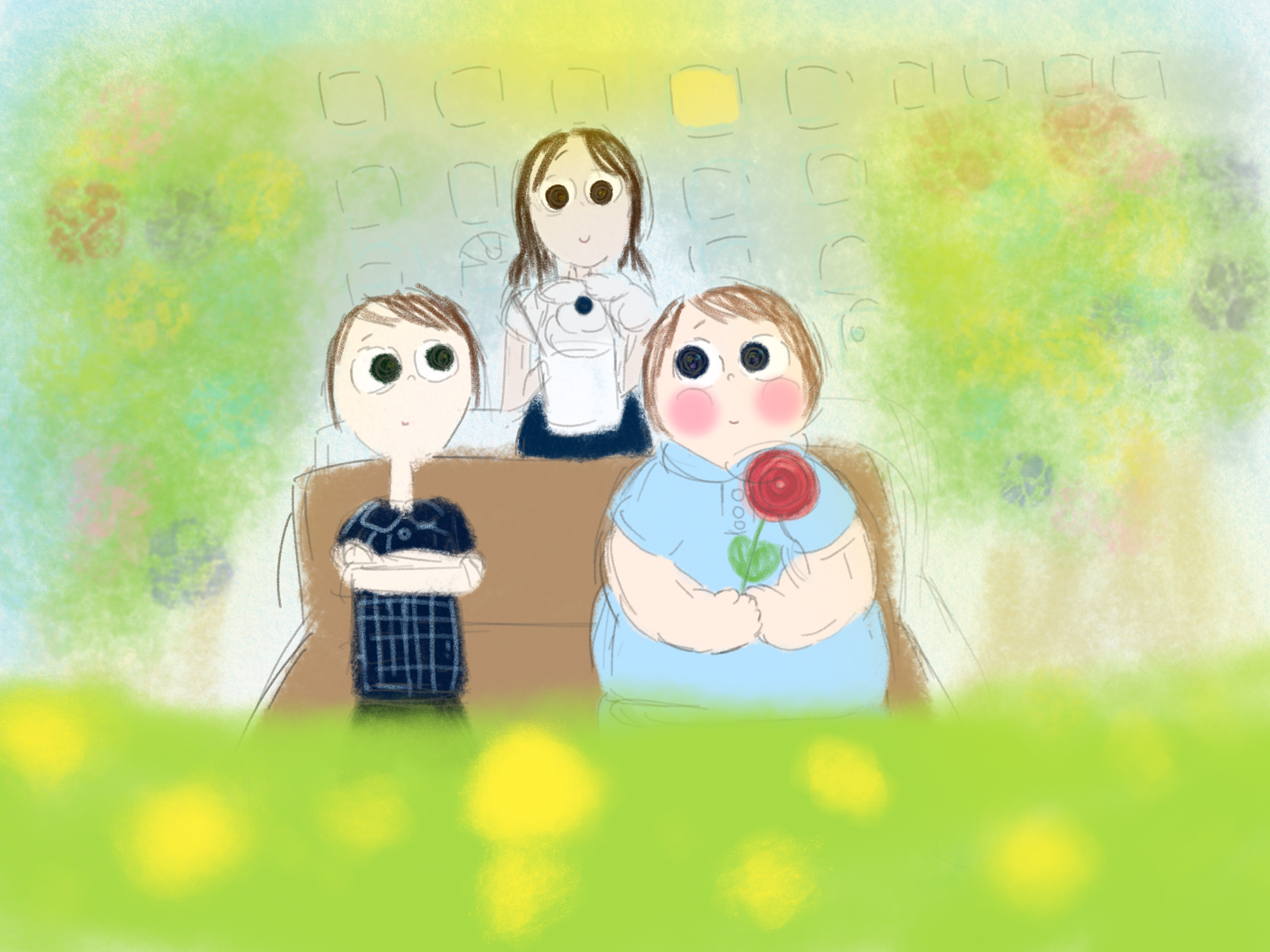
To tell the truth, I have always had a desire to get into a book. When I was beginning to read and the task before me was to analyse a work, I would picture a sunny landscape, and there I was sitting beside the characters, and I could see what houses surrounded us, I could see that street, the people. And I was completely permeated by this world.
My love for the world of the text turned out to be so enormous that I truly found myself in it.
I got into a methodological guide. Yes, such a thing really exists! They took my analysis from the regional stage, gave it two long reviews, and after all that explained that the style would still be corrected, but the potential could be developed.
So here I am sharing it!
☆
At that time, the assignment could offer not only a holistic analysis, or an analysis in the format of an answer to a question. And so, the assignment read:
Read the story and write a detailed answer to the question: «How does the titular hero relate to the other characters?»
I did not know what a titular hero was. Or I confused it. At any rate, I thought that the titular hero was the one who stands «behind the main one» — that is, second in significance and role in the work. I thought that this task seemed far more difficult, because in this case it turns out to be the narrator, and he, as we know, loves to philosophize, to reflect, and at once his inner world is revealed so wonderfully. Besides, one can look at the protagonist from a new, interesting point of view. Therefore I completely entered into this text, began to observe, and to write down my analysis in the format of an answer to the question posed.
The material is taken from the book: Svirina N.M., Obukhova M.Yu., Glazunova O.I. Preparing Pupils for the All-Russian Literature Olympiad for Schoolchildren: a teaching aid / compiled and edited by N.M. Svirina. – St. Petersburg: St. Petersburg APPO, 2020. – 104 p. – (St. Petersburg Experience of General Education). – ISBN 978-5-7434-0805-4. I wrote the Olympiad work itself. I share it, the reviews with the corresponding authorship, and a little preface to the section from the book.
«In this chapter, teachers preparing schoolchildren for the Olympiad are offered an acquaintance with two independent fragments of works analysing the stories offered in task 2. For the 9th grades the story «Borya» by V. Shukshin was offered, for the 10th grades — the story «The Raven» by I. Bunin. Besides the texts of the works of the participants who advanced to the next round and in the spring of 2019 became prize-winners of the All-Russian Literature Olympiad for Schoolchildren, the reader will become acquainted with reviews of these works by members of the jury of the regional stage of the All-Russian Literature Olympiad for Schoolchildren of the 2018/2019 and 2019/2020 academic years.
Of course, the teacher of literature will themselves see both the imperfections, the shortcomings of the given examples of analysis of the stories, and the undoubted merits of the works performed, the potential of the upperclass girls. At the same time, it is very useful to compare one's own pedagogical ideas about the level, the pluses and minuses of the analysis of a story by an Olympiad participant and by representatives of the professional community who mark the whole array of Olympiad works.
The given fragments of the works are presented without editorial correction. These pupil texts may prove useful both in work with upperclassmen in the classroom and in preparing schoolchildren to participate in Olympiads».
Darina P., pupil of the 9th grade. Task 2.1
Hurry up and get out of here — anywhere!
It is precisely with this phrase that Vasily Shukshin ends his story «Borya». At first this may seem strange, for the whole narrative treats this very «here» quite positively: the narrator as an observer is interested in the people of this place, their actions, their behaviour…
A quite logical question arises: what is it that arouses the narrator's interest in the protagonist Borya? How does this very narrator relate to the other characters?
It must be said that our narrator is a lover of reflecting, of «philosophizing». That is precisely why his position is at first difficult to reveal, but if one reads carefully into his monologues, we will see that Borya is special for him. And not so much in the physical sense as in the spiritual. The narrator feels endlessly sorry for him, the narrator endlessly does not understand what kind of inner world Borya has — how is one to understand it? How is one to understand it, if the others either do not want to understand, or mock him, or else pretend not to notice at all?
It turns out that the narrator, unlike the other characters (whom he also tries to analyse and equally does not understand, just as they do not understand him), is a thinking person, but at the same time constantly conducting experiments on people and evaluating their behaviour.
And yet sometimes one ought to stop in the analysis and give free rein to feelings — to show compassion, for instance.
The narrator himself tells us about this when he reflects on life: «all of us — from Napoleon to Borya — are clumsy, stupid actors…»
Did you notice the allusion? It is not for nothing that Shukshin inserts here an allusion to Shakespeare, who believed that the whole world is a theatre.
It turns out that in his 1973 the author decided to return to this very interesting theme. Why?
One should recall that to create an image one must take into account not only his interactions with other characters, but also the setting into which he is immersed, the time and the character of the time into which the hero is to be immersed.
The seventies of the last century. Long ago the red carnations faded on the grave of the unknown soldier; the post-war years have passed — even the thaw has passed. The country is entering a stable path of development of socialism. Amazing films appear about reality rather than about an invented «ideal» world that never existed; something else appears on the bookshelves besides production novels and Lenin's correspondence with someone unknown…
People change too, and therefore so do literary heroes. At any rate, Russian literature is in an active search for the image of a positive hero. What should he be like, if time is running forward so quickly?
Shukshin presents to the reader something innovative — something that no author before him had done — he presents to us a problematic (physically problematic) hero, endowing him with positive character traits («an all-embracing, calm goodwill», «he is generally kind»).
The narrator amply fulfils his task — he analyses, compares, sympathizes with the «superfluous man» Borya. So it turns out that what was said about the theatre was correct — the local narrator so permeates his speech with endless reflections, with descriptions of every little thing (invariably with tropes), that to some extent he gets carried away playing the observer of unprotected groups of the population.
Look: he is like a «Chameleon» from Chekhov's story of the same name — now one life position, now another; now he speaks in one style of speech, now suddenly jumps to another. In the narrative, «philosophizings» suddenly appear (reflections: «I thought», «I noticed», «this is above us», «wherefore — therefore», and so on); descriptions («…in Borya's eyes — an all-embracing, calm goodwill…»).
This is all because the protagonist is non-standard, new for Russian literature and for that time. So it is interesting for the narrator to look from various sides at the behaviour of the hero whom the author invented for the sake of an experiment on the reader.
When you realize all this, you feel sorry not so much for Borya as for the narrator. To preserve a sound mind in such a mad setting is no easy matter. Moreover, on the way one constantly encounters boors and simply strange people — here is the «gorilla» mocking Borya, and Borya's ward-mates, who do not interest our narrator at all.
And it turns out that our narrator is to some extent himself a «superfluous» man — for it is not for nothing that he is interested precisely in Borya, because somewhere deep in Borya there sits sincerity and goodwill; it is not for nothing that he tells us for so long about pity — for he pities himself. He pities himself watching the «gorilla» do nasty things to an already poor man, he pities Borya. As it was so well said then: «I feel sorry for the little bird…»
In fact, the narrator — unlike the protagonist — is a simple and understandable person. It is only at the beginning of the story that he tries to «philosophize» and put on masks. The last phrase explains everything: «Hurry up and get out of here — anywhere!» He is tired of analysing, he is tired of this «stuffy», depressing setting. And no wonder: if all the other characters were his antagonists, like the «gorilla», one could expect admiration: «A carriage for me, a carriage!»
But the life of a literary character does not end. In this era he is perceived one way, in the next absolutely differently. And yet for our poor, pitying and pitiful narrator the question will still stand: «What then is life — a comedy or a tragedy?»
Reviews of the work of Darina P., pupil of the 9th grade
Tatyana Yakovlevna Yeryomina, Honoured Teacher of the Russian Federation, teacher of Russian language and literature at Gymnasium 406 of the Pushkin District of St. Petersburg
Darina P. analyses V. Shukshin's story «Borya» on the basis of an understanding of the compositional structure, of the comparison of the points of view of the author — the narrator — the characters. Given the time limit, the analyst has the right not to consider all structural levels, paying attention to the most important ones from the point of view of the author's tasks.
The mention of the narrator already at the beginning of the work shows that the pupil sees the difference between him and the author; then she repeatedly shows the distance between them. Although this thought is not carried through to the end in the finale, the transition from talking about the narrator to the writer's intention shows the depth of understanding of the artistic text. Also important is the correlation of the actions and consciousness of the characters, of artistic time — with the real time of the story's creation. What is missing, however, is an indication of the reasons for the different attitudes toward the incomprehensible «Borya». But the move toward the theme of the «physically problematic» positive hero is original, the conclusion about this is independent, though what is lacking is precisely a concrete comparison with the theme in other authors.
Nevertheless, one can see knowledge of the history of literature that is serious for the 9th grade, including terminology used correctly, not excessively. The quoted recollection of Chatsky and the «stuffy» society looks logical. The reflections on the features of the text are well-founded, the quotation is appropriate and sufficient.
Let us note some shortcomings of the work, most of which are excusable given the pupil's age. The place of action is not directly indicated. Elements of dialogization in the middle of the reflections simplify the analysis: «Did you notice the allusion?»; «Look» — the work here resembles a journalistic rather than a critical article. Somewhat comical and creating a stylistic breakdown is the quotation from the romance («long ago faded»), apparently not recognized by Darina. Nor, apparently, is the quotation from the film («I feel sorry for the little bird») fully understood — and there is no reference to the source («As it was so well said then»).
Further, the clichés of Soviet journalism worsen the impression of stylistic heterogeneity («the country is entering a stable path of development of socialism»). This is a departure both from the text and from the circle of V. Shukshin's attention. Although the meanings of words mastered by the reader are not always stylistically appropriate («the narrator amply fulfils his task»; «gets carried away playing the observer of unprotected strata of the population»), the inferences are essentially correct.
Let us emphasize the skilful construction of the work, begun with a non-accidental quotation that is most important in meaning: at once the consciousness of the hero and, probably, of the author is conveyed. The quotation requires explanations, and further — a natural thickening of questions, also requiring explanation. «How is one to understand» — already in an indirect question, «difficult to reveal» — a statement of a personal task. The words «strange», «here» (a pronominal adverb) — the vocabulary is chosen for the beginning of a problematic reflection.
Somewhat unfortunate from the point of view of lexical meaning is the choice of comparison of the narrator with the «Chameleon»: the change of types of speech is a different theme. But the mention of Chekhov is important, and it is a pity that this thought is abandoned: there is no mention (9th grade!), for example, of «Ward No. 6», although both the theme of madness, and even the word ward, and the theme of freedom or persecution sound in Shukshin. There is also an observer situated inside the ward. But the constant comparison of the hero-narrator and the author is a deep approach to understanding the text. («Hurry up and get out of here — anywhere» — is also a reference to the speech of the hero from Chekhov's story «The Teacher of Literature».)
Skilfully, closer to the end of the work, the exclamation mentioned at the beginning is quoted again — now it is explained and leads to the conclusions. It is important that the work is also finished with a quotation — it leads to a deep generalization, without cancelling the absence of final answers in the writer Shukshin.
One has to note a small number of grammatical errors (several times in different variants «also — as well», 2 missing commas).
On the whole, however, the impression of Darina Pogosian's work is very good; it deserves a high mark.
Marina Yuryevna Obukhova, director of GBOU School No. 47 named after D.S. Likhachev, head of the club at GBNOU «St. Petersburg City Palace of Youth Creativity» Anichkov Lyceum for preparation for the All-Russian Literature Olympiad, deputy chairman of the jury of the regional stage of the All-Russian Literature Olympiad for Schoolchildren
Before proceeding to the analysis of Darina P.'s work, it should be noted that this is the work of a ninth-grader, and the level of difficulty of the text for the 9th grade at the regional stage of the All-Russian Literature Olympiad in the 2018/2019 academic year did not differ from the texts for the 10th and 11th grades.
Darina P.'s work demonstrates a sufficiently deep understanding of the intention of Shukshin's story «Borya», as well as a comprehension of the question that had to be answered in analysing the text: «The author's attitude toward the titular hero». One of the main mistakes of those who chose Shukshin's story «Borya» for analysis was the conflation of the concepts of «main» and «titular» hero, which in the end led to the whole work being conducted from the outset in an unassigned direction. Dwelling on the logic of the construction of the work, one would like to draw attention to the device used by the ninth-grader.
Beginning the work, she wrote out at the very start a quotation that, in her opinion, defined the main idea of the story: «Hurry up and get out of here — anywhere». Such a beginning allowed her to build the work in the form of a question-and-answer narrative, which made it possible to unite the thoughts that arose during the analysis of the text. At the same time, one cannot fail to notice an unjustified logical link existing in the work: trying to build a transition from one thought to another, the ninth-grader introduced into the text a lyrical digression, «Long ago the red carnations faded…». This and the following paragraph have no relation to Shukshin's story; the striving for grandiloquence led to the interruption of the thought: «What is interesting about the new hero who appeared in Shukshin's work?» Also unjustifiably drawn out is the beginning of the work; Darina takes a long time to arrive at one of the key phrases of the work: «All of us — from Napoleon to Borya — are clumsy, stupid actors». The pupil manages to arrive at the thought that «all our life is a game», in which people play like theatrical actors. Unfortunately, she did not manage to develop this thought. Attention should have been paid to the fact that Shukshin places in one row Napoleon — a historical figure — and Borya — a mentally ill person with «the consciousness of a two-year-old child». Stupid and terrible is the thought of the one who wants to conquer the world. But what did Borya want and does he want? He wanted his mother to buy him a rose, a symbol of beauty and harmony. His mother did not do this, Borya beat her, and she «gave» him to the hospital. Desiring harmony, he himself violated it (raised his hand against his mother), and then waited all the time for his mother to come for him and forgive him, because the harmony in this world is founded on a mother's forgiveness: a mother loves, a mother will always forgive a child. Indeed, the dream of world domination is stupid. And the dream of universal harmony and justice? Apparently, this question remains in the story without an obvious answer, because further the events unfold according to other laws of society.
The multi-dimensionality of the analysis of the artistic text offered at the Literature Olympiad is a feature of this task. One of the main criteria of assessment is the pupil's ability to independently determine the methods and devices of analysis, the structure and sequence of the presentation of thoughts. It is important that the analysis of the text should lead the pupil-reader to an understanding of the author's intention, his picture of the world, to a vision and explanation of the ways in which the writer expressed his position. The analysis of the text is conducted by the pupil in order to try to see the work as a «complexly organized unity… of constructed meaning» (Yu.M. Lotman), and in their written work to tell about this.
One of the merits of the reviewed work is the pupil's ability to focus attention on the features of the construction of the story offered for analysis; for example, Darina notes that Shukshin reveals the inner world of the hero by emphasizing his monologues. Thereby the pupil demonstrates command of the theoretical-literary conceptual apparatus and the ability to use terms correctly, without artificially complicating the text of the work.
Analysing the pupil's work, unfortunately, one cannot fail to note in it the presence of speech errors («the further life of the character», «one could have expected admiration from the narrator if all the other heroes were his antagonists», and so on). The absence of speech errors is one of the criteria by which a pupil can gain an additional 5 points. Since what we have before us is an Olympiad work in literature, it should be noted that there are considerably fewer non-gross speech errors here, but practically all of them are taken into account in the assessment.
The ninth-grader draws a clear line between the author and the narrator. Emphasizing that evil in the person of the Gorilla is punished (three little men stood up for the defenceless Borya), Darina, however, does not draw a conclusion about the narrator's attitude to such a turn of events: «hurry up and get out of here — anywhere». It turns out that in this world good must have fists. But then is it good? There is no answer to this question in the story, and the narrator, perhaps, therefore gazes for a long time into Borya's eyes, but never arrives at the conclusion of what life is — «a comedy or a tragedy?»
Concluding the review of Darina's work, one would like to note that the members of the regional jury in literature, noting individual shortcomings in the work, were able to see the pupil's potential. Between the regional and the final stages in literature several months pass, during which intensive additional classes are held, the shortcomings of each work are analysed, and variants of correcting them are proposed and discussed. Undoubtedly, in Darina's work one can trace the ability to analyse a text, to turn appropriately to the historical-cultural context, a inclination toward the search for the author's position, and one can see the skill of comparing the offered story with other works of literature; there are no unjustifiably used literary-scholarly terms.