The Story of One Performance

Мы загрузимся через одно мгновение!

This is my work from the second, creative round of the final stage of the All-Russian Literature Olympiad for schoolchildren, 2019 — a staging based on M.E. Saltykov-Shchedrin's novel The History of a Town (link to the tasks). I chose to publish this particular staging, because it is the most interesting one. I present it here with underlinings, comments, and the jury's review. I think it may be useful.
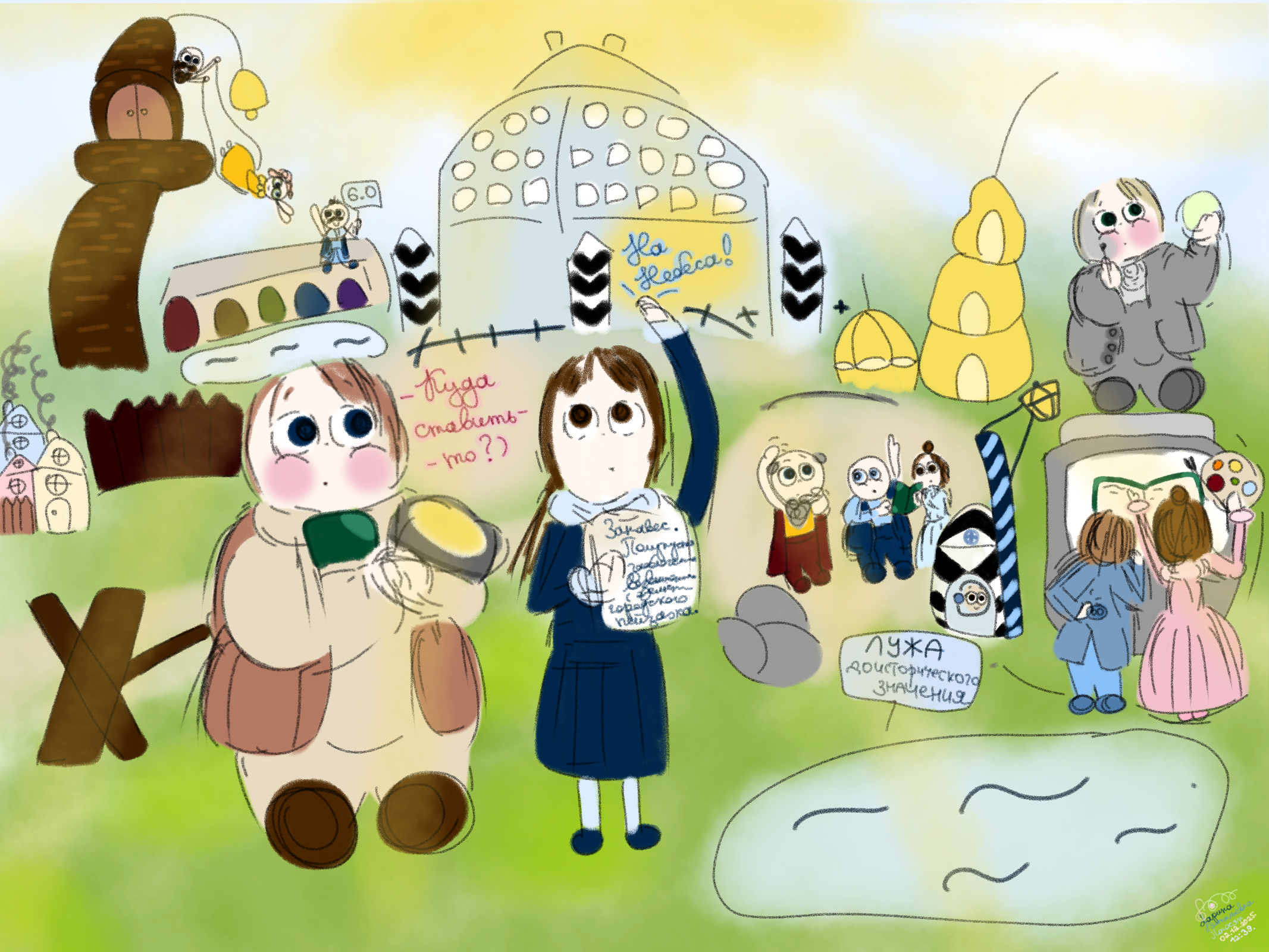
The creative round changed my whole life.
I know the novel The History of a Town very well. It was one of my favourite works in the eighth and ninth grades. I read and reread it many times.
And when I received the assignment, I undoubtedly saw it in the pictures accompanying the task. I did not doubt for a moment, because the justifications were born from every artistic detail present in them.
The entire content of the essay descended upon me like a revelation. I sat and wrote as if someone were guiding my hand — swiftly, intensely, decisively. And I left the room joyful, beside myself.
Our group's chaperone looked at me with hope in her smiling eyes and asked:
— Well? The Government Inspector?
With a tremendous radiance on my face, I answered her:
— No! The History of a Town!
And all the days until the review, we worried. What was that? Was it meant to be a guessing game? How would the work be graded?
And at the review of the creative assignment, a great Miracle happened. It is one of the most tender events that have ever happened to me in my whole life.
The first thing we were told was that the assignment had not been a guessing game. And that "the most brilliant work was written not on The Government Inspector."
And then they turned to that work. And I heard: "The curtain opens." And they analysed my work beginning from the opening of the curtain, reading out fragments, presenting the mise-en-scènes.
I am so in awe before God for what happened — for the inspiration, for the pictures, for the review, for the examiners — that I thank Him to this day as for one of the happiest events in my life.
I invite you to read my work too!
I present it below. The first task I did in the most ordinary way. And the second follows after!

Task.
Task No. 2. Examine the sketch and the photo of the stage sets from different theatrical productions of one and the same work (fig. 2 and 3).
- For which performance do you think such a design was used? Why do you think so? Justify your answer with examples from the literary work.
- What interpretive tasks did each artist solve? How do the selection of details and their arrangement, light and colour, the construction of the stage space and the placement of characters within it express the meaning of the production?
- What details, in your opinion, could appropriately supplement the stage design in each performance?
- What acoustic design of the performance could correspond to the atmosphere set by the sets? Describe what combinations of sounds or sound-noise effects could be used in the performances.
For your answer, you may choose the form of an analytical review or an essayistic reflection. Try to rely on the suggested questions. Your work must be a whole, coherent, thoughtfully constructed text (approximate volume – 400–450 words). Choose a precise, short title for it.
Criteria of assessment (maximum score – 30):
1. Capacity, precision, expressiveness of the title, its correspondence to the chosen format of the task.
2. Persuasiveness of the argumentation in explaining the choice of the work, reliance on the particular features of the problematic and the figurative structure of the literary text.
3. Reasoned characterisation of the visual series of the performance, the appropriateness of the proposed additional details of the stage design, their correspondence to the literary source.
4. Justification and originality of the acoustic design proposed in the work, its correspondence to the overall conception of the performance.
5. Compositional harmony, logical coherence of the text.
6. Correctness of speech, stylistic expressiveness of the text.
The Story of One Performance.

The curtain. A half-empty, boggy elevation with elements of an urban landscape. It is hard to believe that behind this crumbling wooden structure, resembling a woodpile more than a fence, lies a city. Even worse — the central square of the city. With the building of the Assembly of the Nobility, with a bell tower, and for some reason with a stable…
On the curtain — the town of Glupov.
That it is Glupov is evident from everything — take at least the bell tower in the background. One should recall the notes of the town's archivist — the narrator in Mikhail Evgrafovich Saltykov-Shchedrin's satirical novel The History of a Town. It is known that in the "Century of Female Rule," unwanted town-governesses were thrown from the bell tower — for example, the wife of Pyotr Petrovich Ferdy-shchenko…
In the background, but already to the right of the building of the Assembly of the Nobility (of which all that is known is that the square on which it stood was several times dismantled into stones in order to erect a monument to yet another town-governor), there looms the distorted silhouette of the Peter and Paul Fortress, which reminds us that Glupov is a parody of the Russian Empire, a satire mocking the state apparatus of the time when Petersburg was still the capital.
The silhouette of the Peter and Paul Fortress and other landmarks of the town are reflected in the river, which resembles, rather, a puddle. It must be said that this river has flowed in Glupov since "prehistoric" times: when the tribe of the Head-Bangers was trying to find itself a prince, "only on the way they drowned in a puddle as many as got lost in three pine trees…" Since then this puddle has been called a river, in which unwanted town-governors are not infrequently drowned. They even tried to remove it at some point, when one of the last heads of state took it into his head to destroy the town and build a new one, Nepreklonsk, in its place.
In front of the puddle — yet another rather unpleasant landmark — a dung heap. Yes, this is precisely a landmark, because in the year when the town-governor Ferdy-shchenko Pyotr Petrovich decided to travel, he got stuck in this heap so many times that "the subjects crawled out of there with difficulty…"
The curtain rises.

On the stage — a most curious picture — sketches of a single room. Behind them or on them — it is impossible to make out — four shadows. The shadows of the town-governors. The first two, the ones furthest to the left — clearly the shadows of those very twins who were sent to the town to rule right after Demen-tiy Varlamovich Brudasty; they were inseparable, "no one ever saw them separately."
The archivist gazes intently at the shadow. Now, probably, he will begin to tell about the town-governors of Glupov, to present to the audience these mysterious figures…
Interesting ideas. Both the sketch of the curtain and the artistic design of the performance… I believe that Saltykov-Shchedrin himself would have taken a liking to these ideas, as they convey quite precisely the atmosphere of Glupov and its mystical component.
The author, of course, did not think that this kind of satirical novel could be staged; still less adapted for the screen — but with time, talented directors and stage designers learned to make even such complex works play. One should recall the screen adaptation of The History of a Town under the title It (1999), where the events of the novel are transferred onto the soil of the twentieth century.
If in It the main role is given to history and to the relationship of history with the people, then here, in the sketches, the artistic detail matters most of all.
In the sketch of the curtain there are depicted, as it turned out, almost all the landscape details characteristic of Glupov. The artists faced the task not only of conveying the atmosphere of the town, its untidiness, its emptiness, but also of letting the audience understand what would happen on the stage: the silhouette of the Peter and Paul Fortress, for example, refers the viewer to Petersburg and hints at the comicality, the worthlessness of Glupov, at its attempt to correspond to reality.
One could add a monument K3 to the aforementioned Ferdy-shchenko and depict villages on both sides of the town, to show that the town is small and that the countryside begins right at the exit from its central streets. Moreover, in the Streltsy Settlement (one of the villages) a fire occurred. That too could be shown; in the same chapter the town is also subjected to famine. Hungry dogs running in the foreground would be appropriate and comical. (unidentified hook)
Accordingly, while the curtain is down, one should introduce the viewer into the narrative with the help of sounds and light. K4 Let us add the howling of hungry dogs and make the lighting dark, predominantly in blue tones, as if the town were asleep and it were still only night; where the village is, one could shine a ginger torch and add to the howling of the dogs the sound of wood crackling from fire. But the cries of "Fire!" K4 should not be added: let the viewer understand how indifferent people in the town are to one another.
Between the chapters of the work, if the curtain is merely to be lowered, one can make a day in the town: let the town also be deserted, so that the viewer listens more attentively, for what happens will be reflected precisely in sounds: everything will be in them. After the first chapter, in which the chronicler introduces twenty-two town-governors into the narrative, there will be a mixing of their characteristic lines. With each new hero a new sound is added. For example:
Archivist: "Pryshch, Ivan Panteleevich…"
The one playing Pryshch steps out of the shadow toward the archivist.
Archivist: "…turned out to have a stuffed head, for which he was exposed by the local marshal of the nobility."
The light abruptly goes out, the sounds of someone munching are heard, supposedly the marshal of the nobility.
The light comes on, the town-governor is already gone. A new one stands in his place, but the munching still reaches us from afar, only more quietly now. Thus, after the announcement of all of them, the archivist begins to feel dizzy from the quantity of mixed sounds, he hides himself, the curtain falls. The sounds die down, but one of them, on the contrary, grows louder: it is the repeated cries of "I will not tolerate it!" and "I will ruin it!" of Demen-tiy Varlamovich Brudasty. Precisely his cries, since according to the plot, immediately after the chapter describing all the town-governors comes The Little Organ.
Thus, after each chapter the curtain falls and the lines of Glupov's heads are heard; at some point all fall silent except one — the very one that will figure in the next act.
I have already spoken about the artistic design of Alexander Borovsky's production and his idea with the shadows. But what happens on the stage when only one town-governor is needed?
Then, I think, the archivist himself goes into the shadow, and the head of Glupov takes his place. Secondary characters — the inhabitants of the town — are also in the shadow. Here one can experiment very well with light.
For example, in the chapter "The Worship of Mammon and Repentance" there is a moment with the holy fool. She tells the Glupovites about the possible end of the world and hides a "little bag of gold" under the ground. On the stage one can single her out from the crowd with the help of light: when she predicts misfortune, a crowd gathers around her, lit in dark tones. Above her herself — something like a sunbeam, directed from her head to the ceiling. The viewer must see this sign and think about her connection with God.
By the way, in general all positive heroes can be lit in yellow tones; for example, the town-governor Semyon Konstantinovich Dvoekurov, whom even the author presents above the others, indicating in his characterisation only positive deeds for his town: he set up a cheese dairy in Glupov, and began to sow mustard in the foreign manner…
But there were also negative characters. After their rule, as a rule, a saving cloud with dust descends upon the town like humanitarian aid to the Glupovites: sometimes it brings bread after a time of famine, or rain after a drought. Here one needs to introduce an unusual sound.
As soon as the cloud appears, one should play the song "From behind the island, on the rapid…" K4? There's a love moment in the song (at the time I meant the first verse, apparently I should have indicated this). Firstly, the cloud brings hope to the Glupovites, like the ships in the song; secondly, it always appears as something positive.
An interesting contrast emerges — the town-governor lit in dark tones "goes into the shadow," and in his place comes something incomprehensible, indefinite, to the accompaniment of this song.
In the finale, when "the sun fell, the town-governor vanished. The Glupovites fell prostrate," suddenly all the Glupovites standing in the shadow are illuminated in bright tones (like that holy fool; this will show their closeness to God, that is, death). Everything disappears, and only a song sounds, very very quietly, in the dark hall: "From behind the island, on the rapid…"
Such a finale will be unusual, since in the novel the history of Glupov ends there, but in the production salvation seems to come again and, perhaps, there was no end of the world at all. This will make the viewer philosophise, perhaps derive their own idea of the finale and of the novel as a whole…
Again… a half-empty, boggy elevation with elements of an urban landscape. The dogs do not howl. The village is not burning. There is nothing but the old heartfelt song, so mysterious and unusual.
The curtain.
☆
K1 - ⅔
K2 - 4/4
K3 - 10 9/10
K4 - 5/5
K5 - 5/5
K6 - 3/3
Total: 28/30
All conditions of the task fulfilled; genre features taken into account
Review from the Score Sheet: A stage script with the movement of mise-en-scènes is presented + all tasks fulfilled.