Echo
Мы загрузимся через одно мгновение!

And I will also tell you about one incredible — event, occurrence, fulfillment? — what shall I call this phenomenon? — I think, an echo. Right now I will tell you what this echo is and why it is called that.
You live and you completely do not think about the actions and deeds that you say, create, perform, without noticing. How will our word echo? It turns out that when you see that the word echoes, this lofty artistic statement turns into a concrete, deep question to yourself.
Recently my mother found this interview: https://www.pravmir.ru/k-odnomu-uroku-mogu-gotovitsya-nedelyu-uchitel-slovesnosti-rimma-hramczova/. I instantly recognized myself in it. Excitement and awe completely seized me — exactly the same feeling that I experienced then, sitting there, touching my whole body starting from the heart, raising my eyebrows, tuning me to readiness to heed, to hear and to listen to the surrounding world, because you see the fine tuning of its inscrutable laws.
It was the work viewing, at which I did not understand at all what would happen next. How had I written — well or badly? But I had the most important thing — a note of confidence in my scores thanks to the creative round.
And I saw a mark in the margins of the analytical round: "Lot.?" Then another one. I asked what it meant. And I really was told which works to read.
That feeling was like the discovery of how truly vast our world is. It turns out that one can, and probably should, refer to the works of literary scholars, precisely because they can deepen your understanding of a literary text. At that moment it seemed to me that before I wrote my work, something had not been told to me, that I had not grown up to something real and worthwhile. I heeded. I was told: to write a good work, you need to refer to literary scholars.
It seizes a child, a pupil, a student — the feeling of discovering the world as an adult. But when a child becomes the creator of their own work, the feeling of discovering the world by oneself begins. And it was precisely this that became the nature of my creative round, for which I was given 52 out of 54 and I received a diploma.
But when I looked at the scores for my work in the analytical round, I was thinking about something entirely different. The analytical round is the mind of a philologist. And I have 35 out of 70 for it. Exactly half. It is clear that my mind was hurt, so I wanted to go to the appeal.
It seemed to me that in the text I had seen everything I could possibly see, and had shown it. And then they began to talk with me. I had the feeling that my eyes had been opened. Two human eyes — rational, logical, grateful. But my third eye, the most faithful, intuitive, and unafraid of creating something inimitable and my own, was already open, and it manifested itself in the creative work… I still consider it one of the best texts I have written in my entire life.
The deed that made it into the interview made me think about myself in a way I had never had to before.
Undoubtedly, I feel gratitude and joy for my younger self. But it is very important to read the whole interview to understand what the matter is.
What matters is not that I was told to refer to someone, but that I accepted it with respect. When I read this interview, I spent several hours searching for that very piece of paper on which I had written it down. I remembered how I bought my first books on literary scholarship at university level. I remember that one of them really was Yu. M. Lotman's The Structure of the Artistic Text. I came home after the All-Russian, bought it, opened it…
And understood nothing in it.
Then a whole year followed — a period of pseudo-scholarship in my life. I wrote my most disastrous regional round. I referred to many books that were listed on the site of Moscow's "School of the Young Philologist." M.L. Gasparov, Yu.M. Lotman, B.V. Tomashevsky, B.M. Eikhenbaum. But who knows how I should have been guided? At the club they continued to develop the ability to think, but the feeling that I was writing not deeply enough, not scholarly enough, not sufficient for a high, genuine level, outstripped my understanding of what needed to be done. I got scared, because I thought: if the summit has been taken, next time a bigger, better, more worthy work is needed.
A year later I returned to the sources. In my second All-Russian, in the 11th grade, I referred to no one. But not because I did not know that such things existed at all, but because I now understood what exists and was aware that, in searching for the meanings of the text, I did not need it just then. And at the work viewing I received not a single remark.
The thing is that the Olympiad really did change over those two years. At the review of the second analytical round, Igor Nikolaevich Sukhikh was greatly indignant at how children refer to works without knowing why it is needed, and search for a multitude of references to works that do not help to understand the meaning. He was almost shouting. I thought: thank God that I did not do that, that I followed my own thought, that I proved my vision of the idea, carried it through the levels of the text and the artistic details, stringing everything onto it.
When I was retyping the text of my first analysis onto the site, I had begun studying for my master's. And I again wanted to understand what this "Lot.?" meant. In my bachelor's my neurons had ripened enough to begin to understand at least something in the gigantic Yu. M. Lotman. Today I still cannot answer the questions of how, in the ninth grade, I could have turned to his works competently and appropriately in such a way as to deepen the analysis of the given text.
I agree with every thought of this wonderful teacher. I do not like it when the All-Russian becomes a system. I do not want it to be possible to prepare for it. From myself I will add — to prepare for it by reading works that a child is not capable of comprehending. Perhaps this is a peculiarity of my perception. After all, peculiarities are not a negative word; they can help reveal all human abilities. Again I will repeat that the work in the creative round is one of the best texts I have written, feeling the weight of the hand of God. I remember the state in which I wrote and walked out of the room. It seemed to me that I was not on Earth. I was all cotton-wool, I could barely walk, I was flying. I remember that state of mine very well. It is the state of a person whose hand was guided by the Creator. That is what makes life worth living.
I do not know whether there are people from this year's team on my channel. I know there are those for whom Olympiads have also become a part of their life. Every time, whatever I write about Olympiads, one and the same idea concludes itself for me. True inspiration has a divine nature. One cannot prepare for it, one cannot read it into oneself. It simply is, like a phenomenon of nature. And in the history of a human life and its creation there will remain only the highest little spark, which a person can direct.
That is why I also agree that in a teacher what matters is not only what he says, but also how, and what kind of person he is. It is spiritual fullness, which is greater than criteria. I now understand that most likely I was advised to read the books not because they wanted me to actually read them — it was a shell for help, whose source lives in the human heart. Most likely it was a delicate pedagogical work, to which I managed to respond correctly. I am glad that I then directed myself toward attention, listening, creation. I tried and read those works. To read and to realize — that was the business of the following years… I am very glad for the children who now know how to correctly turn to a literary-scholarly work. Who can turn to this complex list of literature and identify in books the most important and necessary.
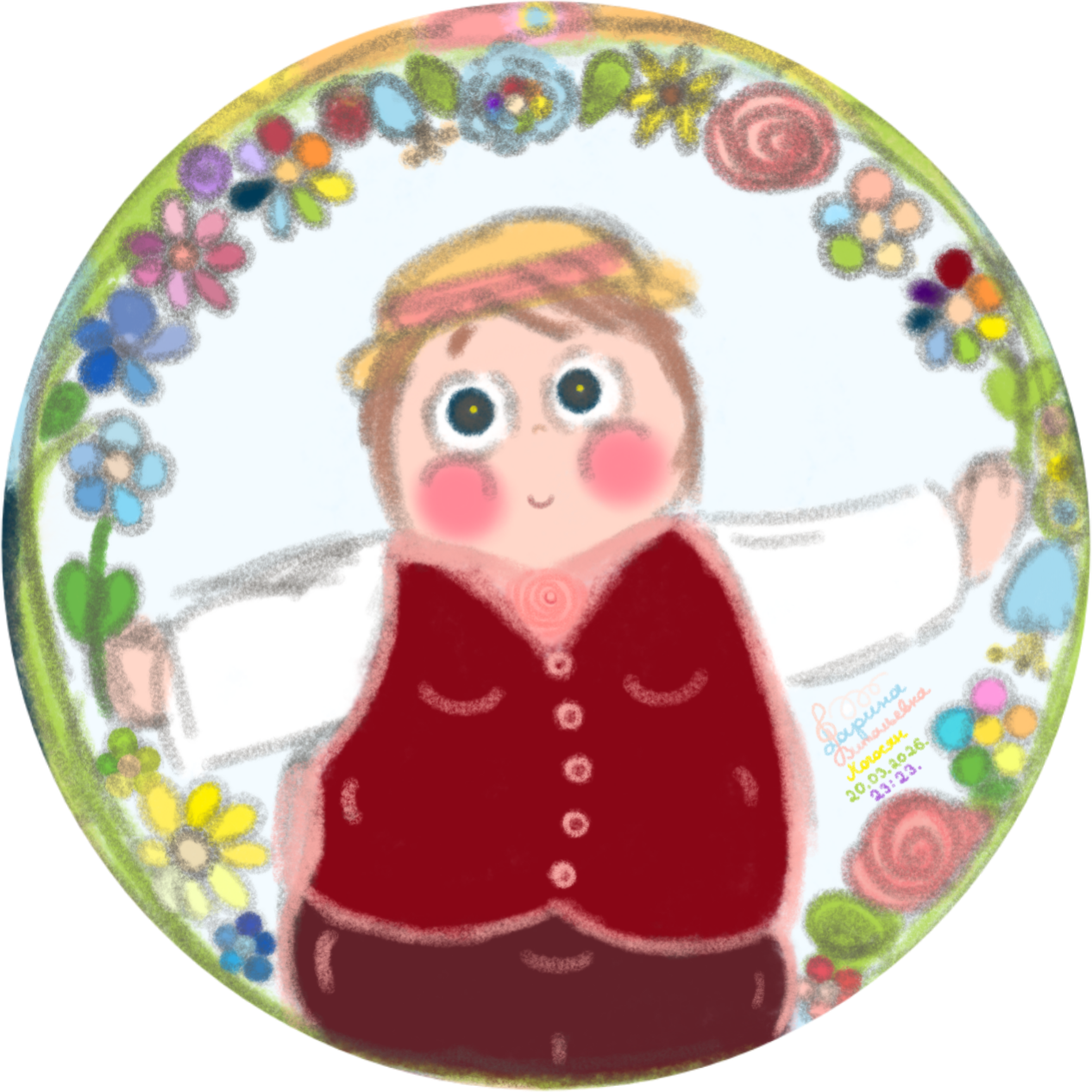
And this picture, this episode from my life — is a reminder that there is a time to speak and a time to listen, to create and to understand what has been created, to create one's own and to build up the work of another. Exactly the same awaited me a month ago at the Academy of Sciences. They did not understand me, but they advised me a long list of literature. Yes, on the history of inspiration. But I am still very grateful. These are very useful materials.
I am finishing this text after a trip to Zelenogradsk and Kaliningrad. When I was there, the All-Russian Olympiad in history was taking place in the city. It is good that someone will have their fulfillments in this city, as I once did.
I congratulate everyone who was involved in the Olympiad movement this year. And in my new capacity I managed to take part to a greater extent — to hold more classes and a whole shift, to check works on the regional jury. This place of the highest fulfillment does not let go — one wants to return to it again and again, as to the source of the very best that a person is capable of, embodying in limited time everything for which their soul is tuned. And the world does not let go either; it keeps and remembers all of it. Just like in this picture.
And this picture — is a reminder that every fulfillment of ours is an echo. Our word will echo. And let them be very good words.