How I marked the works
Мы загрузимся через одно мгновение!
Well, the nerve-racking part is behind us. I think there is enough to calmly analyse what has passed. I can tell you about my work. I will try very hard to compose this text in such a way as not to offend anyone, but at the same time so that it is also useful.
I marked poetry in the eleventh grade. For the most part I gave good marks; personally I came across very remarkable works.
Thank God, the poem I got was a good one, so there was no need to doubt the direction of the theses. But even here it was not always so. For example, it is sad if the poem was connected with the hopelessness of the copyist, with his lack or misunderstanding of the meaning of his life. An interesting pattern emerged: a non-life-affirming idea could not be well argued. That is precisely the point of directing one's work toward the light — positive energy will help find more meanings, because the author did not write the poem for nothing. He always wants to inspire the reader to something greater, better, to show him a more meaningful direction in life: and if one manages to see this, then all levels of the text immediately open up as something due, self-evident, and native.
-
I encountered very many comparisons of the protagonist with Akaky Akakievich. This thought, unfortunately, never received development. But it is important that the hero of the poem is more than a little man. He copies not bureaucratic orders but the most important sacred texts for the whole of culture. Look how many great texts were in his hands, and not just once! Is that a small life? Moreover, the last line, which completely overturns our idea of the hero — is a little man capable of such dignity as he bore throughout the whole text? Norshtein, in his work on The Overcoat, noted that a little man can be a scoundrel, and what a scoundrel. Can we connect the hero of our poem with this side of the little man's soul — with pettiness, with incapacity for a worthy deed? Therefore it is very important: if one is to compare these heroes, then to show how this image develops, in what it is different and incomparably greater.
-
Many things were connected with the historical time. That is understandable, because a whole 7 points are given for cultural-historical context. Hence the fear appears that if you do not connect the text with context, you will get a low mark for it. But to unravel a text, context is not necessarily needed — it can also be subtext. I did not understand this the first time, but later I learned to turn to context correctly, only when it is really needed and helps me understand the meaning of the work. In almost all works there was postmodernism in one way or another; they said that the copyist's confession is the crisis of the postmodern author, who cannot create anything new of his own and therefore can only copy. But it is important that the poem is much larger than this context: first, it is not for nothing that we have so many archaisms; second, the genre itself is so sincere — a confession; and third, remember again how many great texts were in his hands! He does not distort them, does not use fragments in his own creation, does not compose himself out of them, as a postmodern author might do. There is no hopelessness here — the hero recognizes his craft as sacred, he bears it with dignity. So postmodernism did not always really fit into sincere reflections on the poem and was not always confirmed.
-
Unfortunately, all levels of the text were very rarely encountered. It is very joyful to observe when sound patterning is discovered, when the child begins to listen to the poem. Yes, we do not always need all levels of the text to confirm our thought, but the more of them one manages to see, the better!
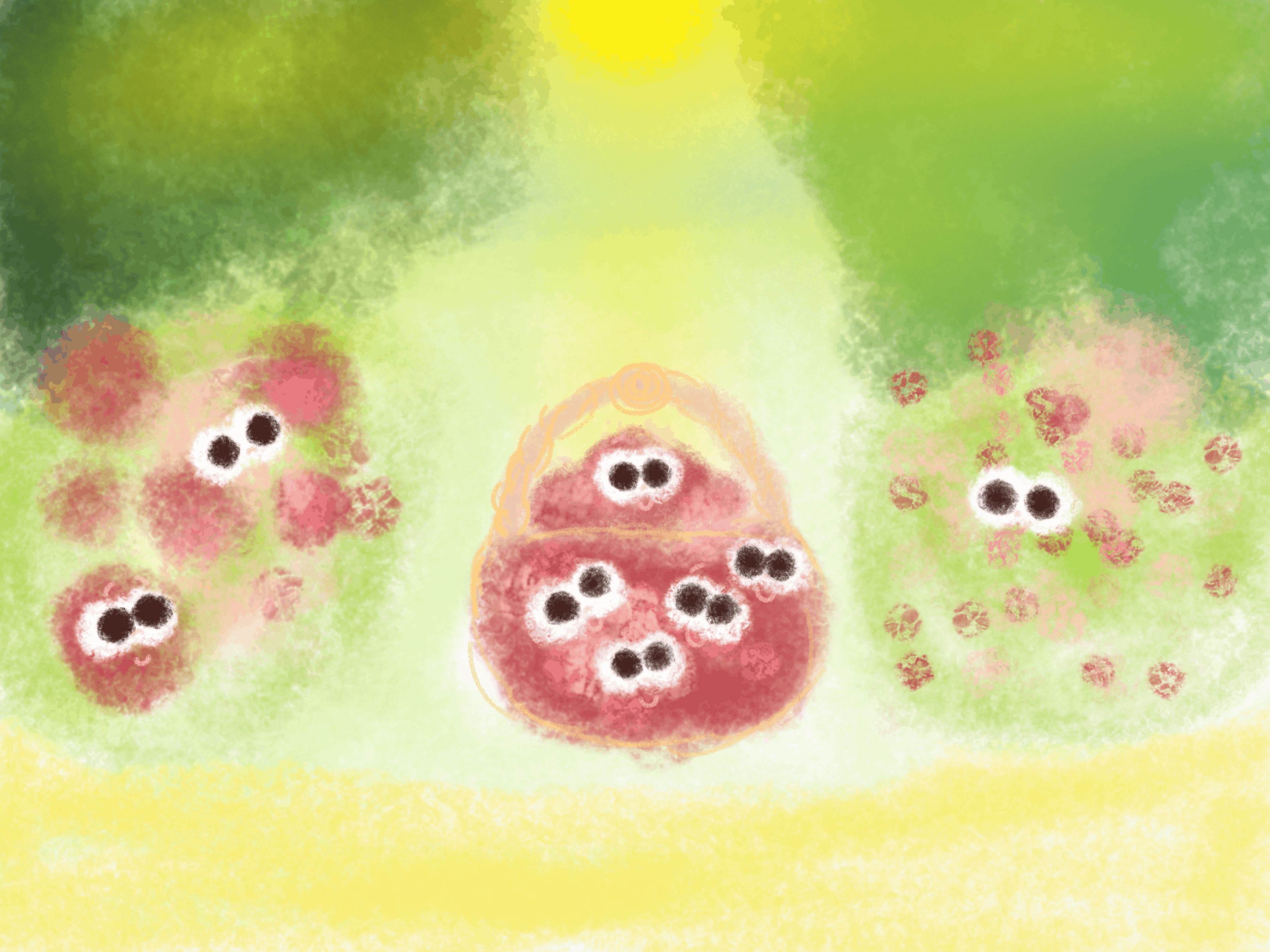
This is like in the fairy tale The Little Pipe and the Jug: do you remember that wild strawberries always hide?

«I pick one berry, look at another, notice a third, and a fourth seems to shimmer». That is exactly how one should string arguments onto one's thesis. We have an idea — confirmation for it is immediately seen in the composition or the system of characters, for example, what is obvious at once. But one must not stop there. But what if there is also sound patterning, rhythm and rhyme, and maybe even the syntactic level of the text (long and short sentences) or punctuation? That is how you will get a little basket. Unfortunately, in most works there were few berries in the basket — one or two. And for the final level, a whole little basket is really required. But such works did exist too, and that is pleasant.
Last year, in the creative task, there was, as a rule, a listing of texts and quotations; the works were not very well connected with the exhibits. And this year, the opposite — the exhibits themselves were described for a long time and in detail. I think the reason is that the wording of the task describes in great detail what exactly the markers want to see in the bringing to life: the system of images, time and space, and so on. And only the last question, the most important for connecting the exhibition and literature, turned out to be one: "Why?"
It was very engaging and interesting. But it is important to connect the exhibits with the text of the work. Not only to describe in detail the dynamics of light, its movement from the first hall to the last, but also to show: why is the light like this now? If this is connected with the character's path in the work — what was happening in the text at that moment, and how does this connect with the setting of the hall in the exhibition? We cannot quote everything and not always, but even indirect quotation is very important. Imagine that the marker is entering your exhibition for the first time, and does not remember all the details of the work. Bring them to life! Show how this image lived in the text, and how it lives in yours.
It is also important to note that with regard to M. Gorky's creative work it is more correct to say not "romanticism" but "neo-romanticism." But at its foundation the idea is correct. I took great pleasure in looking at the different seas in the exhibitions, how it grows from a quiet river into a raging sea, sitting on a blanket listening to the stories of Old Woman Izergil, interacting in the most varied ways with Danko's heart — in what forms it did not appear! Both glowing, and plush, and a little pendant for visitors. And how many more original finds there were — Gypsy songs, the choice of the path of freedom, wings of hope — impossible to convey! So I felt that the images were coming to life. And for that, thank you even more!
It is time to sum up. What I like most:
- It is clear that the text being analysed is loved. The child wants to immerse themselves in the artistic world of the work and does everything so that the world comes to life.
- There is a thesis at the beginning and at the end of the analysis, developed and thorough.
- There are many arguments, almost all levels of the text are present.
- Every thought is supported by a quotation.
- In the creative task the exhibit comes to life in the child's inimitable vision, who understood and showed where it is born from, how it connects with the text of the work.
The most important thing — everyone tried very hard. Whatever happens next — all this will undoubtedly be useful in interpreting texts. All this has already happened. I am very glad that this was in your life. Everyone is a great fellow! And may every image that pushed you to finish the work to the end be met more than once and continue to inspire you.